
Get help with research
Questions?
Tutorials
The following sections provide tutorials in library catalog searching, as well as citations and plagiarism.

Library Instruction - Advanced Searching
Plagiarism
Plagiarism
Resources
- Avoiding plagiarism, self-plagiarism, and other questionable writing practices: A guide to ethical writing
The purpose of this module is to help students, as well as professionals, identify and prevent questionable practices and to develop an awareness of ethical writing. This guide was written by Miguel Roig, PhD, from St. Johns University with funding from ORI. - Cheating in Academics topic page from Credo Reference
- Plagiarism-Overview
- Is It Plagiarism?
- Safe Practices
- Plagiarism Exercise
- Quoting, Paraphrasing, and Summarizing
This handout is intended to help you become more comfortable with the uses of and distinctions among quotations, paraphrases, and summaries. This handout compares and contrasts the three terms, gives some pointers, and includes a short excerpt that you can use to practice these skills. - Grammarly
Grammarly makes sure everything you type is clear, effective, and mistake-free. Grammarly scans your text for common and complex grammatical mistakes, spanning everything from subject-verb agreement to article use to modifier placement.
Research Paper FAQ
Page numbers are reference to:
Raimes, Ann with Maria Jerskey. Keys for Writers. 6th ed. Boston: Wadsworth, 2011. Print.
How do I tell a good source from a bad one?
Although there are no hard rules to deducing a source’s value, the following are some good rules to keep in mind:
- A good source usually has an author.
- A good source is unbiased.
- When using the internet, remember that the better sites will likely end in “.edu” or “.gov”.
- A good source has been published/peer reviewed.
- A good source is either of a time period (historical) or up to date (contemporary).
- A good source does not push an agenda.
How do I recognize a scholarly article? (pg 127)
- It is peer reviewed.
- It refers to the work of scholars in the field with both parenthetical citations and a work cited/ references page.
- It names the author and his or her credentials (educational and/or occupational background)
- It uses academic or technical language.
What is the difference between quoting and paraphrasing? (pg 149)
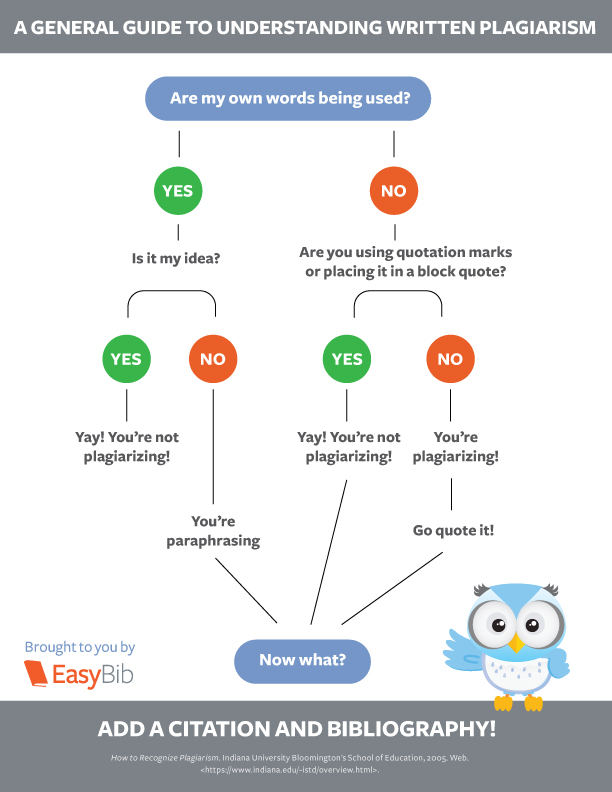
A quoting is when you use the exact words from the source in your text. Quotes should be placed with quotation marks and offset with a proper introduction. Paraphrasing is taking someone’s idea and putting it in your own words. This does not mean simply replacing one or two words (this is plagiarism); proper paraphrasing changes sentence structure, style, and word choice. Instances of both paraphrasing and quoting should be sited!
How do I introduce a quote? (pg 155)
Introducing a quote is important because it clues your reader in to where you are in the scholarly conversation. Think of how puzzled you are when you are following along with a speaker and he or she throws in a random and seemingly unrelated fact; even if they explain the relevance of this fact at some point later in the conversation, that moment of confusion is uncomfortable. Don’t do this to you reader.
Some good introductory phrases are:
| X has pointed out… | According to X… | X has made it clear that… | X insists that… |
| Although X says…, | X explains… | X, a doctor of radiology from Harvard, says… | X says, suggests, states, or writes… |
What are online library subscription databases? (pg 112)
Online library databases are databases of abstracts and full text general and scholarly articles. These articles are often republished from a printed edition of a journal, newspaper, or magazine. This means that with a bit or work, you can find hard copies of these sources outside on the internet. Subscription databases may be general or specific and tend to contain the most current information on a topic. These databases are a good place to refine searches to scholarly (peer-reviewed) texts only.
What are the different types of web sources available? (pg 123-124)
- Online magazines and online scholarly journals- These sources are similar to the sources you will find in the subscription databases with two exceptions. The first being that these sources have no printed publication in circulation; these documents “live” on the internet and you will not be able to find them any other way. The second being that fewer of these articles will be peer- reviewed which makes them less reliable than many of the scholarly articles you will find in a database.
- Online literary texts- These are texts that are out of copyright and free works in the public domain. These are books, plays, or collections of poetry that can be accessed online and, more often than not, a hard copy can also be found. A good source for this type of source is http://www.gutenberg.org/wiki/Main_Page .
- E-Books- These are books that are still under copyright but can be accessed online. RSCC has quite a collection at http://www.netlibrary.com/ .
- Online news sites- These sources are usually the websites of a large news network (i.e. CNN or MSNBC) or a widely published newspaper (i.e. The Wall Street Journal or The New York Times). Note that the articles found on these sites are distinct from those found in the databases because they may or may not be exclusively found on the internet. These sites offer update news as well as archival items.
- Web pages- These are the most prominent web sources. It is important to truly evaluate these sources for validity. A good rule of thumb is to limit the degrees of separation from publisher to topic as much as possible. For instance the University of Tennessee’s webpage on Volunteer Football would be a good source because there is no separation between publisher and topic (this fact is also substantiated with the “.edu” in the URL). However, utsports.com is much less reputable because it is run for profit (.com= company) and separated from UTK by an unknown amount of degrees.
How do I cite something inside my paper? (pg 165)
Whenever you use information that is not your own within your paper, you must include an in-text, or parenthetical, citation. An in-text citation must be used when paraphrasing, commenting on, quoting, or referencing any information from an outside source. Your citation should come right after the referenced information and before the period at the end of the sentence.
The basic formats are as follows:
(Smith 43)- One author with page numbers
(Gardening)- First key word of title- No author, no page numbers (websites)
(Smith)- One author with no page numbers
(Smith and Jones 43)- Two authors with page numbers
(Smith et al. 43)- More than two authors with page numbers
What in-text citation would I use if I have already used the author’s name to introduce a quote? (pg 166)
If you have already referenced the author’s name, all you need to include in the in-text citation is the page number.
For instance:
According to Pulitzer Prize winning author Dr. Jakki Day, “The key to strong writing is a strong story” (57).
How does the in-text citation relate to an entry on my Works Cited Page? (pg 166)
The in-text citation should provide a DIRECT reference to an entry on your Works Cited page. If you do not have an in-text citation for a source, it should not appear on your Works Cited page, and no source should be listed on your Works Cited page that was not referenced in your paper. Simply put, if you did not cite a work in your paper (in-text citation), it cannot appear on your Works Cited page.
These citations are linked so that your reader can find the sources for certain information on their own.
For instance:
Horses are a fantastic pet for teenaged children because they help develop responsibility, communication and health (Smith 43).
As your reader I want to know what else Mr. Smith has to say, so I go to your Works Cited page to find out what source I should go to in order to get more information. Because your in-text and Work’s Cited citations match, I should be able to easily find a citation on your Works Cited page to help me do this.
Smith, John. Horses are Nifty. Memphis: Hall, 2003. Print.
Because you have properly cited your information, I can now go to the page in the book you used and find out more about this information on my own.
How do I cite an article found on Wikipedia?
You don’t. Although Wikipedia is a good place to do some “presearch”, familiarize yourself with a topic, and get some keywords for more scholarly research, it is not a strong enough source to be listed inside of the paper. However, the bottoms of many Wikipedia entries contain links to great articles that may be more appropriate for scholarly research. Use Wikipedia as a starting place, but leave the scholarly references to more heavy hitting reputable sources!
What goes on my Works Cited page; how should it look? (pg 177- )
Your Works Cited page is a listing of every source you used and cited within your paper. Note, just because you read it in your research does not mean it should be included on your Works Cited page. ONLY sources directly referenced in your paper can be included.
These sources should be listed in alphabetical order and formatted properly.
Example:

Additional Resources
Alabama Virtual Library
The Alabama Virtual Library provides all students, teachers, and citizens of the State of Alabama with online access to essential library and information resources. It is primarily a group of online databases that have magazine, journal, and newspaper articles for research. Through the AVL, an equitable core of information sources is available to every student and citizen in Alabama, raising the level of excellence in schools and communities across the state.
Any students that are not in the state of Alabama can still access this amazing resources. It can be access through the Savery Library Online Catalog from the students MyTalladega. If using AVL directly, the student can contact the College Librarian-Library Director and receive a username and password.
Prep-Step (Learning Express)
A dynamic online learning platform from LearningExpress that can change the lives of students through academic success and preparation for today’s workplace. PrepSTEP for Colleges and Universities is packed with tutorials, practice tests, e-books and high-stakes test preparation for self-guided skill building, career preparation and workforce readiness. Core Math and Science Skills, Core English Skills, College Success Skills, Career Preparation, Job and Career Accelerator, Computer Skills Center, Grad School Admissions Preparation, and Placement Test Preparation. Recursos Para Hispanohablantes. Herramientas de aprendizaje, carrera y ciudadanía en español.
Global Road Warrior
Subtitles itself as 'the ultimate guide to the world' or 'the ultimate business travel guide' provides a broad range of practical information, available in twenty broad subject categories, for over 175 countries.